
Mycelium vs. Mycelium-Fermented Grain (MFG): What’s the Difference?
7 minute read

In This Article:
- Don’t Let the Label Fool You
- Mycelium Is Not a Mushroom
- What Is Mycelium-Fermented Grain?
- “Full-Spectrum” Does Not Mean Better
- The Question Nobody Answers
- Pure Mycelium Is Made Differently
- Same Evidence? Not Exactly
- When Buzzwords Do the Heavy Lifting
- Smarter Questions to Ask
Don’t Let the Label Fool You
Words matter. Especially when they appear on a supplement label.
You have probably seen terms like “mushroom,” “fruiting body,” or “mycelium”.
These terms are real. They describe legitimate aspects of fungal biology, cultivation, and extraction. But they are also used in ways that blur important biological differences, making it difficult for you to understand exactly what you are buying.
That is the core issue: products made from very different fungal preparations are often marketed as if they are interchangeable. They are not.
Mushrooms, pure mycelium, and mycelium-fermented grain (MFG) are not the same thing.
They differ in composition, manufacturing, traditional use, and scientific support. Once those categories are separated clearly, mushroom supplement labels start to read very differently.
Mycelium Is Not a Mushroom
Let’s start with the organism itself.
The mycelium is the fungal organism. It is not a root system or a vegetative structure. Those are plant concepts, and fungi are neither plants nor animals. The mycelium lives, feeds, metabolizes, and grows.
When conditions are right, the mycelium can produce a mushroom (fruiting body), a temporary reproductive structure with a specific role in the fungal life cycle.
Put simply:
- Mycelium = the fungal organism
- Mushroom = the reproductive structure [1]
Because the mycelium and the mushroom do different jobs, they produce different chemistry with different potential effects in the body. [2].
This is why terms like “mushroom mycelium” can be confusing. They may sound harmless, but they blur the line between the fungal organism and the mushroom it produces.
The confusion grows with a third category: mycelium-fermented grain.
What Is Mycelium-Fermented Grain?
Mycelium-fermented grain (MFG) is not simply “mycelium.”
It is a mix of two things:
- Fungal mycelium
- The grain it was grown on, usually rice or oats
Why use grain? Because grain is one of the cheapest cultivation methods, the growth cycle is short, and it scales efficiently.
Here’s how it’s commonly made: The mycelium grows through the grain, colonizing it over time. Then the whole thing (mycelium and grain together) is dried and milled into powder.
The important part is this: The grain is never removed.
When mycelium is grown this way, the starch and mycelium are bound together and cannot be separated. Most mycelium supplements can be up to 70% starch because of this method. These grains contain starch and other non-fungal-based metabolites that dilute active compounds. This means the end product is full of starch with very little to non-detectable levels of active compounds.
Not what you want in your mushroom or mycelium supplement.
A simple comparison is tempeh: Tempeh is made by fermenting soybeans with a fungus. The fermentation is real, but the soybean remains a major part of the final food. Mycelium-fermented grain works in a similar way: the fermentation is real, but the grain remains part of the finished material.
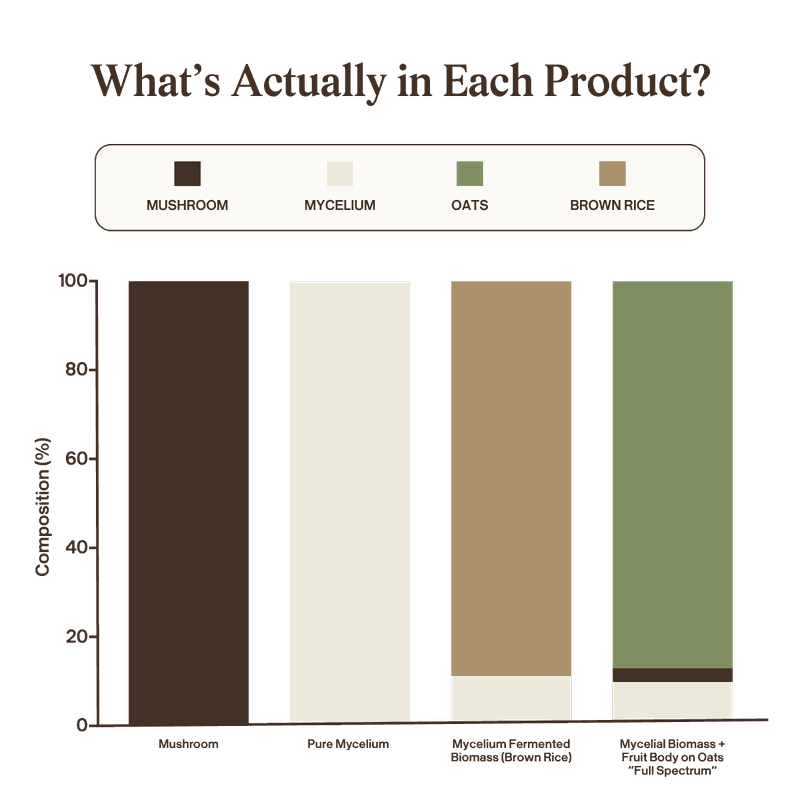
In many cases, you would have no clear way of knowing how much of the final product is fungal material and how much is still grain.
“Full-Spectrum” Does Not Mean Better
Some mycelium-fermented grain products are also marketed as “full-spectrum.”
This sounds good, but if the finished powder is mostly oats, then “full-spectrum” may mostly mean full-spectrum oats.
Starch is the clue. Fungi do not make starch. Grain does. So when a fungal supplement contains high levels of starch, that tells you something important about what is actually in the bottle. [3].
Limited published research also shows that fungal biomass can vary wildly across species, substrate, and fermentation conditions [3,4]. Yet most labels do not clearly show how much of the finished product is actual fungal mycelium.
That makes one question especially important: how much of this product is fungus, and how much is grain?
The Question Nobody Answers
Some brands position these mycelium-fermented grain products as mycelium-driven, while others describe them as unique whole-fermentation, where the grain-fungal matrix is itself the active material.
Either way, the chemistry defining these products remains poorly characterized.
In many cases, commonly measured fungal compounds (such as beta-glucans and ergothioneine) are present at relatively low levels.
This raises a basic scientific question: if these compounds are low in mycelium-fermented grain products, what exactly is driving the biological effects that companies are claiming?
That question deserves clearer answers.
Pure Mycelium Is Made Differently
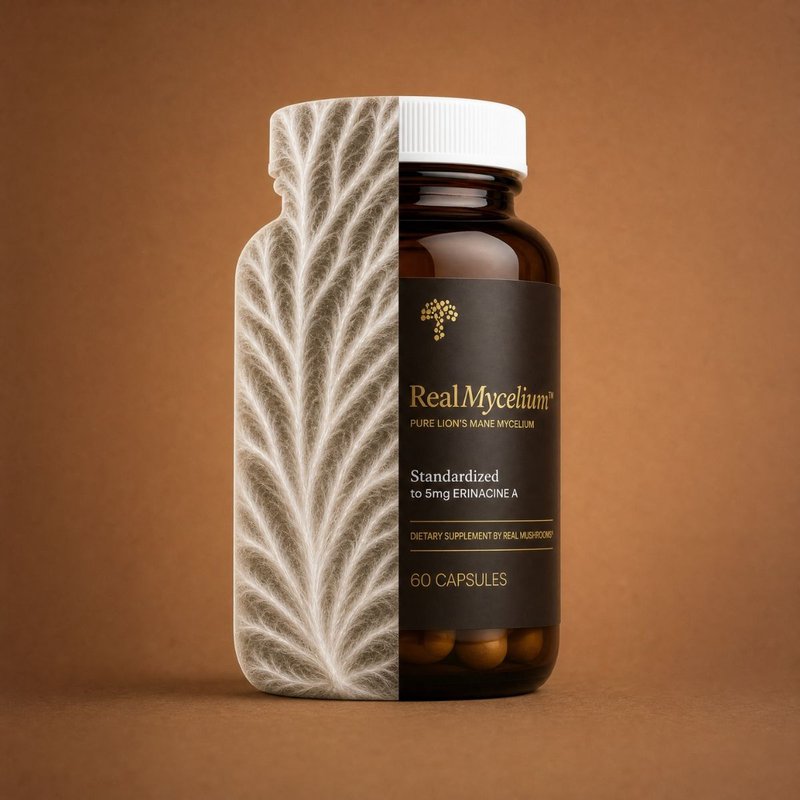
Pure mycelium is produced very differently through a more costly, labour-intensive process. But the results are worth it.
One direct and innovative method is submerged liquid fermentation, where the mycelium is grown in a liquid nutrient medium rather than on grain. This advanced cultivation process is exactly how we produce Real Mycelium™.
Once growth is complete, the liquid is removed, leaving isolated fungal mycelium that can then be:
- Dried
- Extracted as required
- Analyzed
- Chemically characterized
This state-of-the-art approach allows for the production of pure mycelium, providing a level of precision and consistency that is very different from growing mycelium on rice or oats and grinding the whole mass together.
As a result, Real Mycelium™ and mycelium-fermented grain are not compositionally or scientifically the same.
Understanding this distinction is essential when evaluating fungal ingredients, their bioactive compounds, and the research supporting their use.
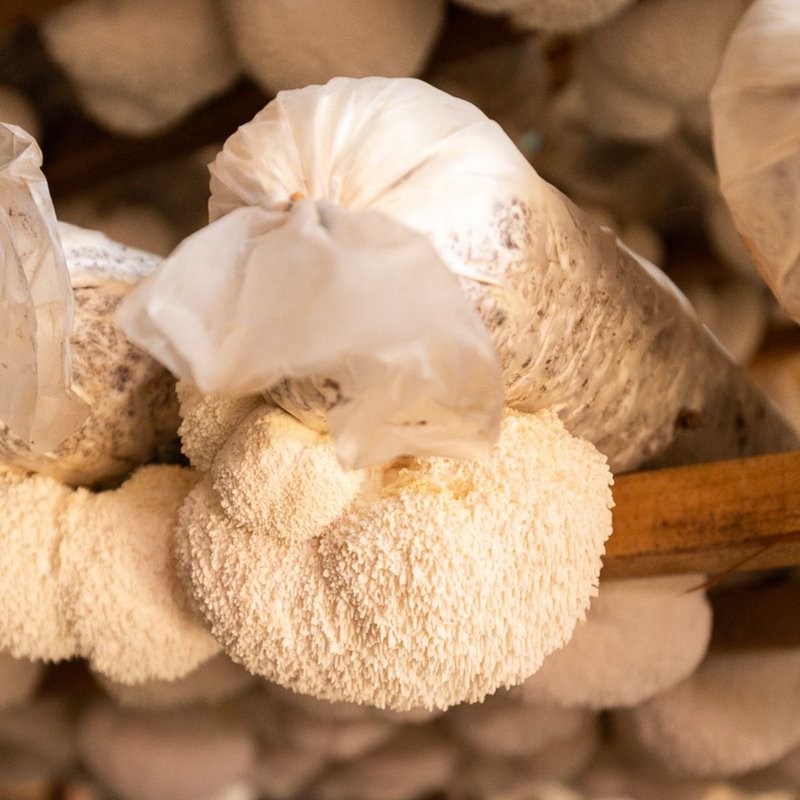
Lion’s Mane offers a useful example.
Lion’s Mane mycelium contains Erinacine A, a compound absent from grain and absent from the mushroom (fruiting body). Some mycelium-fermented grain products reference Erinacine A in their marketing, but detecting a compound is not the same thing as delivering the dose used in research [5].
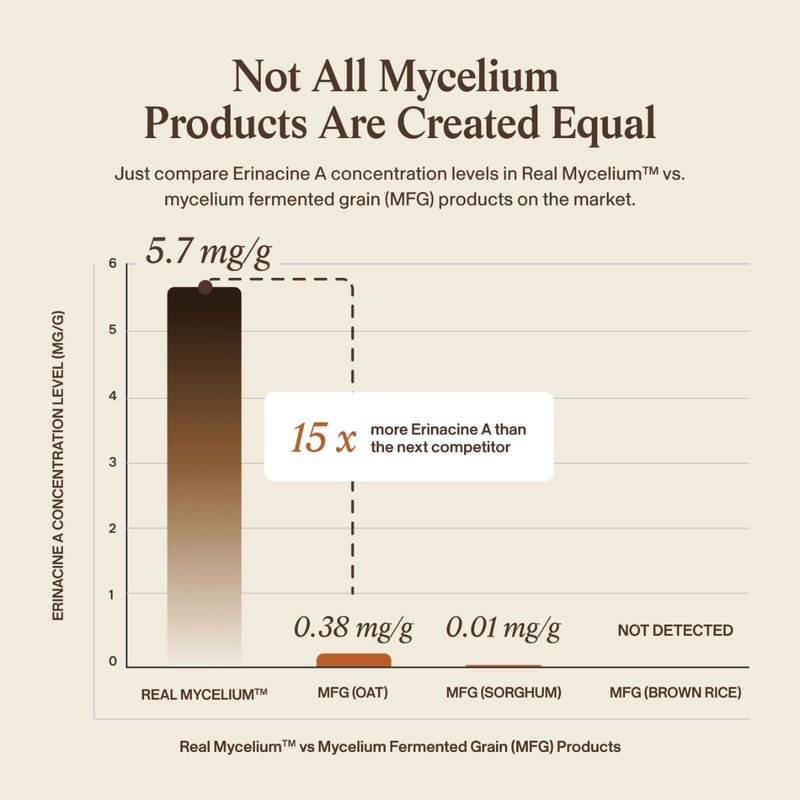
The research on Erinacine A used specific preparations at specific doses. If those amounts are not disclosed on the label, the product cannot meaningfully be matched to the research being cited [6].
This is the key point: pure cultured mycelium has an emerging and legitimate research base of its own. The issue is not whether mycelium has biological activity. The issue is whether very different fungal preparations should be treated as interchangeable. They should not.
Same Evidence? Not Exactly
Traditional use of functional mushrooms, along with modern research on mushrooms and pure mycelium, is based on preparations where the fungal content was known, verified, and concentrated.
That is not the case with mycelium-fermented grain, where the fungal contribution and chemistry are often unknown or undisclosed.
So, research findings cannot automatically be transferred from one material to another just because the label language sounds similar.
A simple way to think about the evidence:
- Mushroom (fruiting body): Long traditional use + extensive modern research
- Pure cultured mycelium: Emerging and legitimate research base
- Mycelium-fermented grain: Limited and often species-specific evidence
This does not mean mycelium-fermented grain is biologically inactive or without value. Some studies suggest potential immune-related effects in certain species and preparations [7]. But evidence is limited, preparation-specific, and far smaller than the evidence base for mushrooms or pure mycelium.
Mycelium-fermented grain also does not share the same history of traditional use as mushrooms or pure cultured mycelium.
Composition determines whether the research is actually relevant.
When Buzzwords Do the Heavy Lifting
Much of the confusion surrounding mushroom supplements is ultimately a language problem.
Terms such as:
- “full-spectrum”
- “biomass”
- “mushroom mycelium”
- and even simply “mushroom”
can create the impression that very different materials are compositionally equivalent [8]. Often they are not.
The issue is not whether fermentation can produce biologically active products. It can.
The issue is whether claims derived from mushrooms or pure mycelium can legitimately be applied to mycelium-fermented-grain products where the actual fungal contribution is unknown.
Transparent labeling would make this much easier to understand.
Smarter Questions to Ask
The real question is not: “Does this product contain mycelium?”
Most products in this category will say yes.
More useful questions are:
- What compounds were actually measured?
- At what levels?
- Was the actual fungal mycelium quantified?
- How much grain or substrate remains?
- Does the product match the preparation used in the research being cited?
- Do the claims match the clinical research?
Once biology, manufacturing, and evidence are separated clearly, many mushroom supplement labels become far easier to interpret.
The takeaway is simple: mushrooms, pure mycelium, and mycelium-fermented grain are not interchangeable. Same words, different biology.
Related Articles
- Real Mycelium™: The Erinacine A Advantage
- Lion’s Mane Mushroom Benefits: A Complete Supplement Guide
- Lion’s Mane for Dummies: A Friendly Guide to the Smart Mushroom
References
- Moore D, Robson GD, Trinci APJ. 21st Century Guidebook to Fungi. Cambridge University Press; 2011 (reprinted 2013). https://www.davidmoore.org.uk/21st_Century_Guidebook_to_Fungi_PLATINUM/index.htm
- Friedman M. Chemistry, Nutrition, and Health-Promoting Properties of Hericium erinaceus (Lion's Mane) Mushroom Fruiting Bodies and Mycelia and Their Bioactive Compounds. J Agric Food Chem. 2015 Aug 19;63(32):7108-23. https://doi.org/10.1021/acs.jafc.5b02914
- McCleary, B. V., & Draga, A. (2016). Measurement of β-glucan in mushrooms and mycelial products. Journal of AOAC International, 99(2), 364–373. https://doi.org/10.5740/jaoacint.15-0289
- Zwinkels J, van Oorschot S, van Mastrigt O, Smid EJ. The potential of mycelium from mushroom-producing fungi in alternative protein production: a focus on fungal growth, metabolism, and nutrition. Curr Res Food Sci. 2025 Dec 15;12:101278. https://doi.org/10.1016/j.crfs.2025.101278
- Corana F, et al. Metabolites in Hericium erinaceus Mycelium, Primordium, and Sporophore. Molecules. 2019;24(17):3511. https://doi.org/10.3390/molecules24193511
- Bizjak, M., Hladnik, M., Bandelj, D., Gregori, A., & Kranjc, K. (2024). Effect of erinacine A-enriched Hericium erinaceus supplementation on cognition: A randomized, double-blind, placebo-controlled pilot study. Journal of Functional Foods, 115, 106120. https://doi.org/10.1016/j.jff.2024.106120
- Saxe, G., Smith, C.N., Golshan, S. et al. Polypore mushroom mycelia as an adjunct to COVID-19 vaccination: a randomized clinical trial. BMC Immunol 27, 24 (2026). https://doi.org/10.1186/s12865-026-00809-9
- NAMMEX. Citizen Petition to the U.S. FDA Regarding Labeling of Mushroom and Mycelium Products. 2023. Available from: https://downloads.regulations.gov/FDA-2023-P-2340-0029/attachment_1.pdf


