
Mushrooms vs. Mycelium for Dummies: The Fungal Life Cycle Explained
5 minute read

When most people think of fungi, they picture a mushroom pushing up from the forest floor or growing from a tree trunk.
But that mushroom is only one part of a much larger story.
Understanding the fungal life cycle helps explain why mushrooms and mycelium are not the same thing, why they contain different compounds, and why different parts of the fungal organism may be valuable in different ways.
In This Article:
- What Is Mycelium?
- Why Fungi Produce Mushrooms
- Mushrooms vs. Mycelium: Different Parts, Different Jobs
- Reishi: An Example of Mushroom Chemistry
- Lion’s Mane: An Example of Mycelium Chemistry
- Traditional Use to Modern Research
- Why the Fungal Lifecycle Matters
What Is Mycelium?
Mycelium is often described as the "root-like" part of a fungus, but that comparison can be misleading.
Roots belong to plants, and fungi are neither plants nor animals. More importantly, describing mycelium as “roots” can make the mushroom seem like the main organism and the mycelium merely a support structure.
In reality, the opposite is true.
The mycelium is the fungus.
Mycelium is made up of countless microscopic threads called hyphae. Together, these threads form a vast living network that explores its environment, gathers nutrients, responds to changing conditions, and supports the growth and reproduction of the organism.
A simple way to think about it:
- The mushroom is like the apple
- The mycelium is like the apple tree
Just as an apple is produced by a tree, a mushroom is produced by the fungal organism.
Why Fungi Produce Mushrooms
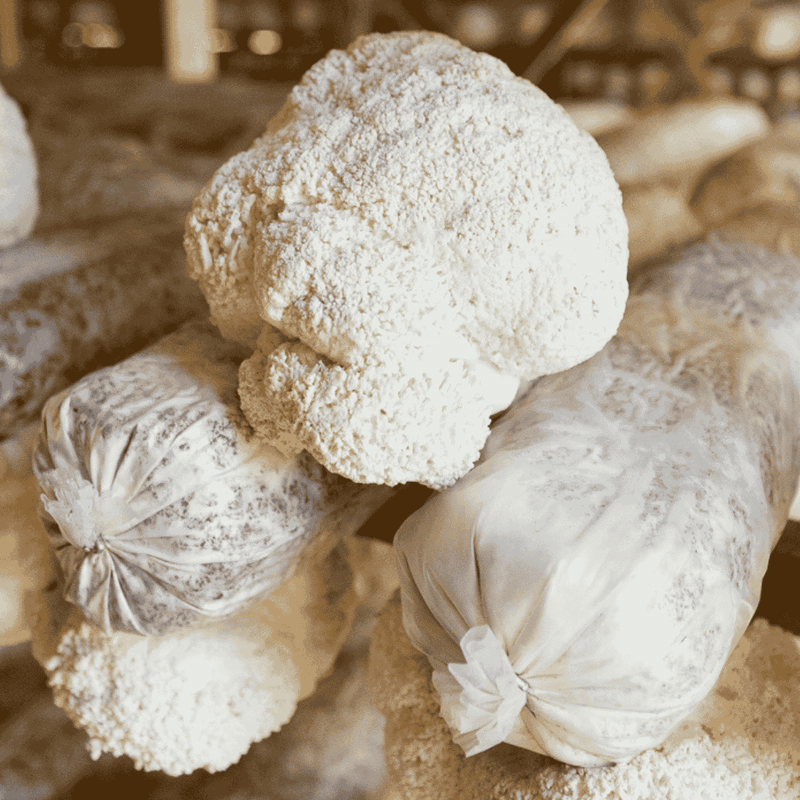
When environmental conditions are right, the mycelium shifts into reproductive mode and produces a mushroom, also known as a fruiting body.
The mushroom’s main job is reproduction.
It produces and releases spores, which are similar in function to seeds. Those spores travel into the environment, where they may germinate and grow into new fungal networks.
In simple terms, the life cycle of a mushroom-producing fungus looks like this:
- Spores begin the cycle
- Hyphae grow from the spores
- Mycelium forms as the hyphae expand into a network
- Mushrooms (fruiting bodies) appear when the fungus is ready to reproduce
- Spores are released, and the cycle begins again
While mushrooms are only one stage of the fungal lifecycle, they are the stage humans have interacted with most throughout history. They are visible, harvestable, and traditionally consumed as food and medicine in many cultures.
Mycelium, on the other hand, remained largely hidden underground, inside wood, or within other substrates. Making it harder to observe, harder to separate, and harder to study (until modern cultivation methods made that possible).
Mushrooms vs. Mycelium: Different Parts, Different Jobs
One of the most important things to understand is that mushrooms and mycelium do different jobs.
- Mycelium is responsible for feeding, growth, survival, and adaptation
- The mushroom is responsible for reproduction
Because of this, they also produce different chemistry. While some compounds overlap between mushroom and mycelium, others may be more concentrated in one part than the other.
That does not mean one part is always “better” than the other. It means they are not automatically interchangeable.
To understand a fungal ingredient, it helps to ask:
- Which part of the organism is being used?
- Is it the mushroom, the mycelium, or both?
- What compounds is that part known to contain?
- Has that specific form been studied?
Reishi: An Example of Mushroom Chemistry
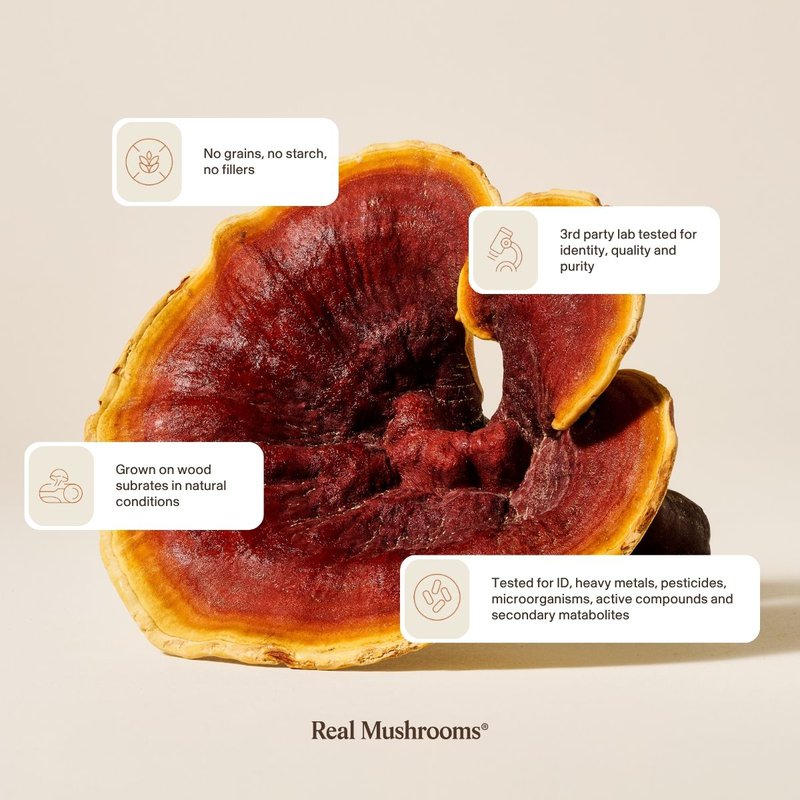
Reishi provides a good example.
Reishi mushroom is rich in triterpenes, which are naturally bitter compounds believed to help protect it from herbivores and environmental stress.
Triterpenes are considered by many researchers to be among Reishi's most important bioactive compounds, contributing to many of the ways it has been studied and traditionally valued..
Reishi mycelium is different.
Because the Reishi mushroom lives protected within its substrate, it faces a different environment than the mushroom does. As a result, Reishi mycelium appears to produce little to no triterpenes.
That difference matters.
It means Reishi mushroom and Reishi mycelium should not automatically be viewed as the same ingredient.
Lion’s Mane: An Example of Mycelium Chemistry
Lion's Mane provides another example.
The Lion’s Mane mushroom contains hericenones, while Lion’s Mane mycelium contains erinacines. Both come from the same fungus, but they are chemically distinct.
That difference has made Lion’s Mane mycelium especially interesting to scientists. In some species, mycelium can produce unique compounds that are not found in the same amounts, or at all, in the fruiting body.
For Lion’s Mane, the distinction is easy to see:
- Lion’s Mane mushroom: contains hericenones
- Lion’s Mane mycelium: contains erinacines
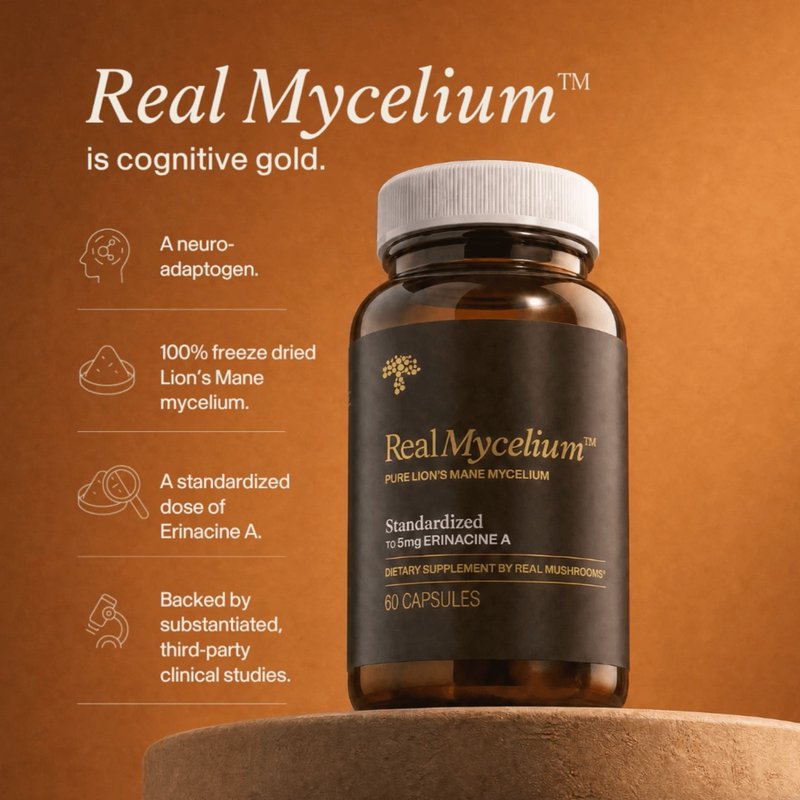
- Erinacine A: one of the best-known erinacines, with human clinical research exploring its role in supporting normal nervous system function, cognitive health, and nerve growth factor pathways
This shows why the specific part of the fungus matters.
The mushroom and the mycelium may come from the same organism, but they do not always offer the same chemistry.
Traditional Use to Modern Research
Mushrooms have been used by humans for thousands of years. They are visible, recognizable, and have a long history of use in traditional wellness systems around the world.
Mycelium is different. It has always been part of the fungal organism, but it was not as easy for humans to see, harvest, or study.
Modern cultivation methods, especially liquid-culture fermentation, have changed that. Researchers can now grow 100% pure mycelium in controlled environments and study it more directly.
This approach has opened the door to a deeper understanding of fungal biology and the many different compounds fungi can produce throughout their life cycle.
Learn more about the innovative production method behind Real Mycelium™ here.
Why the Fungal Lifecycle Matters
Mushrooms and mycelium are different stages of the fungal lifecycle. They belong to the same organism, but they do not always contain the same compounds or serve the same purpose.
At the simplest level:
- The mushroom is the reproductive structure
- The mycelium is the main living network
Depending on the species, the differences between the two may be modest or substantial. That is why mushrooms and mycelium should not automatically be treated as interchangeable.
Mushrooms remain foundational. They are the form humans have traditionally consumed and the source of much of our understanding of functional fungi.
At the same time, modern research is revealing that mycelium has its own story to tell. In some species, it may contain unique compounds that offer new opportunities for research and innovation.
Rather than replacing mushrooms, these discoveries help complete the picture. To understand fungi, we need to look at the whole organism: the hidden network, the visible mushroom, and the many ways they may contribute to health and well-being.
Related Articles:
- Real Mycelium™: The Erinacine A Advantage
- Mycelium vs. Mycelium-Fermented Grain (MFG): What’s the Difference?
- Lion’s Mane Mushroom Benefits: A Complete Supplement Guide
- Lion’s Mane for Dummies: A Friendly Guide to the Smart Mushroom


